Skyblog · Special places
Death Valley in Winter: The Best Season for a Trip From Las Vegas
Mild days, cool nights and the lowest point in North America about two hours from Las Vegas: how to plan a winter visit to Death Valley National Park.
Published November 14, 2026
Death Valley is famous for heat. The world record for the highest air temperature, 57°C, was set at Furnace Creek in July 1913, and summer days there still often top 49°C in the shade. That reputation hides the park's best-kept secret: in winter, it becomes one of the most pleasant places in the American West.
From late fall through spring, the National Park Service describes the weather as very pleasant, with mild daytime temperatures in the low elevations and cool nights that only occasionally reach freezing. Sunny skies are the norm. Add salt flats below sea level, sculpted badlands, sand dunes and the night skies of an International Dark Sky Park, all about two hours by car from Las Vegas, and you have a winter escape that feels like another planet.
Getting there from Las Vegas
Las Vegas is the natural gateway. According to the park, the fastest route runs through Pahrump, Nevada: from Interstate 15, take NV 160 to Pahrump, turn left on Bell Vista Road just north of town, continue to Death Valley Junction, then turn right on CA 127 and quickly left on CA 190 into the park. The whole drive is about 190 km and takes roughly 2 hours.
Plan on renting a car. There is no public transportation to or within the park, so most visitors explore by private vehicle or with a permitted tour group. Don't rely only on your GPS: the park warns that navigation to remote locations here is notoriously unreliable and has sent travelers to dead-end or closed roads, so carry an up-to-date road map. The Furnace Creek Visitor Center has no street address; the park publishes its map coordinates instead.
Fill your tank before you go. There are only three gas stations in the park, at Furnace Creek, Stovepipe Wells and Panamint Springs, and there is no cell phone service along most park roads.
Badwater Road: the classic first drive
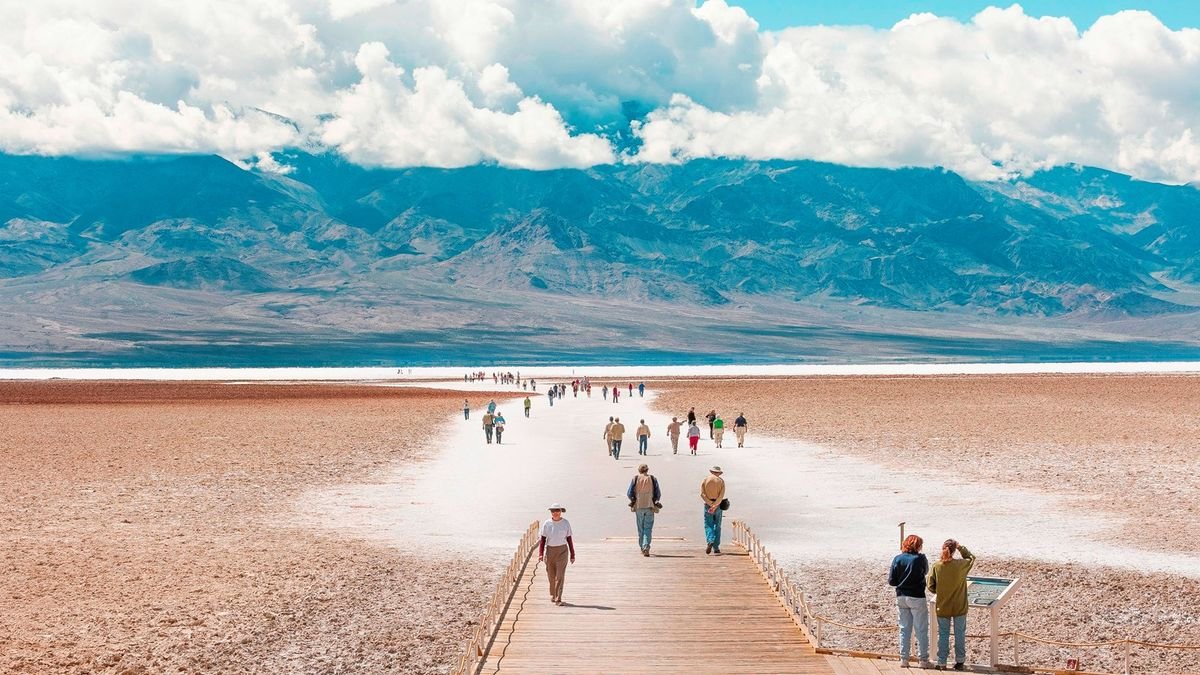
If you have only a few hours, the park recommends its most popular drive, Badwater Road. It leads to Badwater Basin, about 29 km south of the Furnace Creek Visitor Center and, at 86 m below sea level, the lowest point in North America. The salt flats here cover about 500 square km and are made mostly of table salt. Walk out onto the flats to see the geometric salt polygons that form as groundwater rises and evaporates.
The park's own short itinerary pairs Badwater with the Devils Golf Course and a return along Artists Drive, which together take about an hour and a half round trip. Add Zabriskie Point if you are continuing east, or the sand dunes if you are heading west, and you have a satisfying two-hour introduction to the valley.
One rule worth knowing: no boats, kayaks, paddleboards or other flotation devices are allowed anywhere in the park.
Sunrise, sunset and dark skies
Winter's long, clear evenings are made for Death Valley's viewpoints. The park lists Dantes View, Zabriskie Point and the sand dunes as the most popular places for sunrise, and Zabriskie Point, the dunes, Artists Palette and Aguereberry Point for sunset.
Dantes View deserves a special trip. It sits on the ridge of the Black Mountains, 1,699 m above Badwater Basin, with a sweeping view of the white salt flats and the Panamint Range beyond. It is about a 45-minute drive from Furnace Creek, and a short walk north along the ridge usually brings some solitude.
Stay out after dark if you can. Death Valley is an International Dark Sky Park, and the park notes that a visit during a new moon reveals the Milky Way, while under a full moon the salt flats glow white below the overlook.
Where to stay and what to pack
Holidays in fall, winter and spring are peak visitation times, so book lodging or camping early. The park has nine developed campgrounds. Furnace Creek Campground takes reservations from mid-October through mid-April; the others are first come, first served.
Even in winter, pack for the desert. Bring plenty of water in the car, sun protection and warm layers for the evening, because higher elevations are cooler than the valley floor: temperatures drop about 2 to 3°C for every 300 m you climb. Wind is common, and dust storms can blow up quickly with approaching cold fronts. Help can be many hours away, so the park asks visitors to travel prepared to look after themselves.
Before you arrive, buy your entrance pass online. The park does not accept cash, and visitors entering on a dirt road can pay in advance on Recreation.gov and display a printed pass on the dashboard. Check the official fees page for current pass options.
Stretch the trip into spring
If you can wait a little, the season gets even better. When rain falls in several storms through winter and spring, Death Valley can produce spectacular wildflower displays: late March and early April in the low elevations, April and May at mid elevations, and into June in the mountains. Blooms are never guaranteed, so check the park's current conditions before you plan around them.
Frequently asked questions
What is the best time of year to visit Death Valley?
Winter and spring. The park describes those seasons as very pleasant, with mild daytime temperatures in the low elevations and cool nights that only occasionally reach freezing. Summer is extreme, with days that often top 49°C in the shade.
How long is the drive from Las Vegas to Death Valley?
About 2 hours. The park's recommended fastest route goes through Pahrump, Nevada, on NV 160 and Bell Vista Road, then CA 127 and CA 190 into the park, for a total of roughly 190 km.
Can you visit Death Valley in one day from Las Vegas?
Yes. With about four hours of driving round trip, focus on Badwater Road: Badwater Basin, the Devils Golf Course and Artists Drive take about an hour and a half, and you can add Zabriskie Point or the sand dunes. Two days let you add sunrise at Dantes View and stargazing.
Is there public transportation to Death Valley National Park?
No. There is no public transportation to or within the park. Most visitors drive their own or a rental car, or join a permitted tour group. Fill up before you go, since there are only three gas stations in the park.
Do I need cash to enter Death Valley?
No, and cash is not accepted. Death Valley is a cashless park, so buy your entrance pass by card or online in advance on Recreation.gov. Check the park's fees page for current pass types.
Sources
- Frequently Asked Questions, Death Valley National Park · National Park Service
- Weather, Death Valley National Park · National Park Service
- Directions, Death Valley National Park · National Park Service
- Badwater Basin · National Park Service
- Dantes View · National Park Service
- Fees & Passes, Death Valley National Park · National Park Service